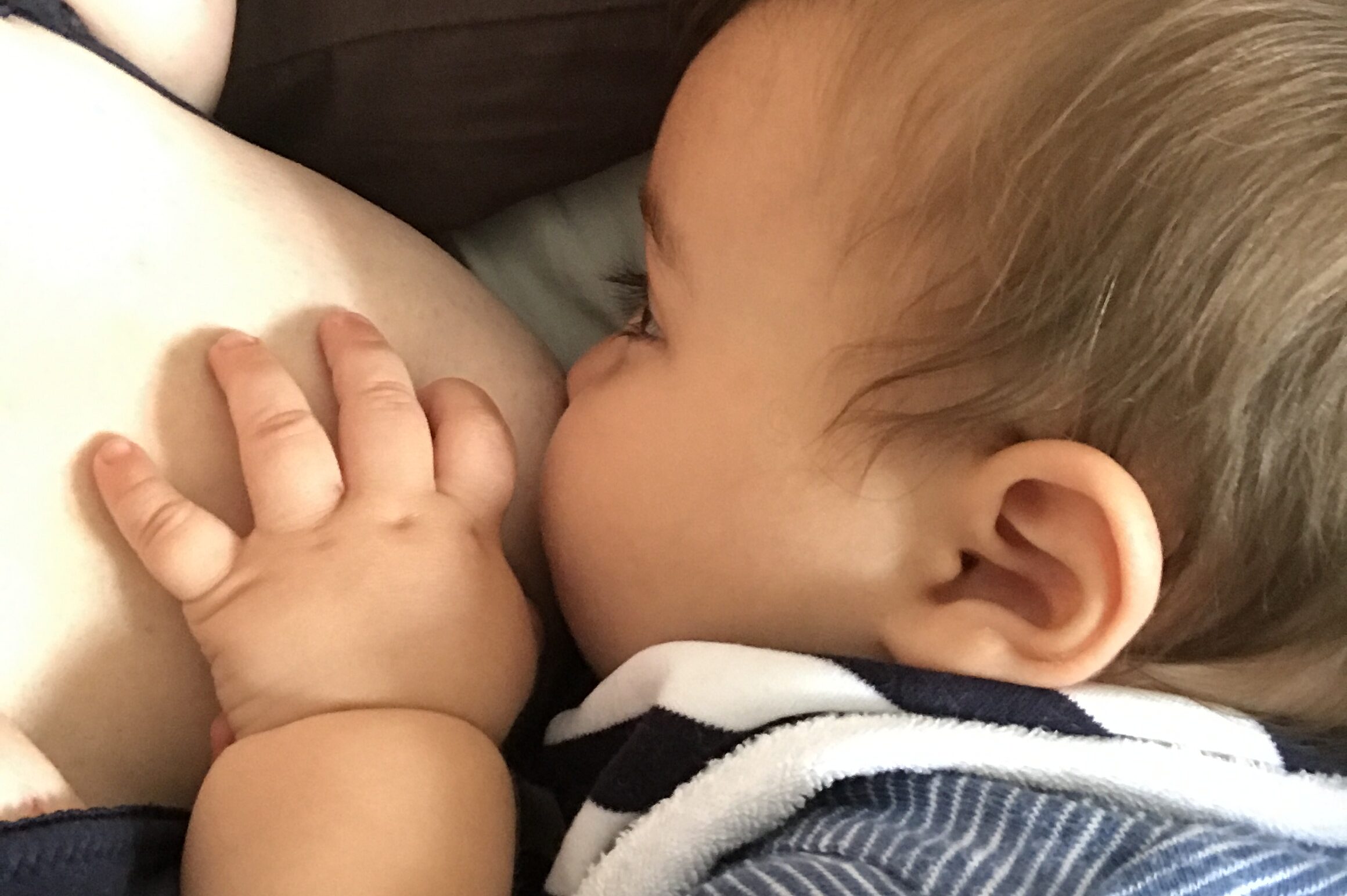
Breastfeeding can take a little time to feel comfortable, even if you’ve breastfed before. You’re learning and baby is learning. In the past, we would have learned to breastfeed by watching other parents around us. Now, new parents often start with very little first-hand experience, and very often with no support.
Why positioning and attachment matter
For you, a good position and a deep latch make feeds more sustainable, so you’re more likely to reach your breastfeeding goals. It means feeding is pain-free, as it should be. It also helps your milk supply settle and stay well established, which protects your supply in the long term.
For baby, a deep latch means they can remove milk efficiently and get exactly what they need. That helps with weight gain and plenty of wet and dirty nappies, and it can help clear jaundice more quickly too. Feeds can feel calmer and more settled for both of you.
Watch for baby’s early cues
Try to offer the breast when you’re both calm. Early hunger cues include:
- stirring
- sucking on hands
- smacking lips
- turning towards you
- getting a bit fussy
But trust your instincts too. If in doubt, get that boob out!
A calm baby is usually less tired and more willing to work a little harder at latching. It’s less stressful for you too.
If baby is too worked up to latch, take a break. Give them a cuddle, take them for some fresh air round the block or in the garden, and take some deep breaths yourself. Sometimes a big crying mouth can be a chance to latch, but some babies really object to that!
Skin to skin
Skin to skin can be so, so important. Babies rely on their instincts to survive, and skin to skin helps those instincts kick in. It benefits both of you: it calms everyone down and helps regulate baby’s heart rate and breathing. Baby feels safe and secure with your touch and the sound of your heartbeat, and it helps keep their temperature steady, whatever the weather.
It helps breastfeeding too. It releases the hormones that support breastfeeding, gets baby interested in feeding, and can help your milk supply. Babies who are given time to find the breast and latch themselves often feed better later on. UNICEF Baby Friendly has more on the benefits of skin-to-skin contact.
Babies are born with strong instincts to find the breast, and many will even crawl towards it on their own. Letting them follow those instincts can really help from the start.
Watch: Breastfeeding in the First Hours (Global Health Media Project)
Get comfy and hold baby close
First, get yourself really comfortable: feet up, a pillow behind your back and shoulders relaxed. You can do this once baby has latched if that feels easier. The more comfortable you are to start with, the easier positioning and attachment will be to master, and the more sustainable breastfeeding will be long term.
Make sure baby is completely facing you, so they don’t need to turn their head to reach the breast.
Often babies are too far away from you and too far forward. Their head ends up near your armpit with their nose at the nipple, when their bottom should be nearer your armpit. Think chin first, with baby’s head more central to your chest.
You want baby’s tummy and bottom really, really close to you, so close not even a piece of paper could get between you. Babies need full body contact to feel safe and secure.
Baby should have one arm over your breast and one underneath, as if they’re hugging it, like a little super baby flying! Tuck their bottom in as far back as you can, into your elbow or armpit, and really squish it in with your elbow.
Once baby is on, gently move them towards their feet so their chin lifts off their chest, their nose is clear of the breast, and their chin sinks deep into your breast. In the cradle hold, the easiest way to do this is to slowly move baby towards their feet until there’s a wide gap between their chin and chest and their nose is completely clear. Try not to move your body, only move baby.
Very important: make sure nothing is holding baby’s head, not even a finger. You can support their neck and back, but their head needs to be free to move so they can tip it back. Think of taking a sip of water. You tip your head back to swallow, and that’s exactly what you’re aiming for with baby.
Reclining slightly with pillows behind you helps too, because your body supports baby’s weight instead of your arms.
Finally, take your time. It’s completely fine if baby gets a little unsettled while you work on the latch. A deep latch is worth the patience.
Try different positions
There’s no one best position. It’s whichever feels most comfortable and sustainable for you, and the one you feel will see you through long term. Laid-back can really help a baby who is struggling, though.
Laid-back: you lean back and let baby’s instincts guide them to the breast. Especially helpful after a difficult birth, if baby is sleepy, or if they’re finding latching hard.
Cradle hold: the classic one, but it can be tricky at first. Keep baby’s tummy against yours and support their body so neither of you is straining.
Cross-cradle hold: like the cradle hold, but your hand supports baby’s neck and shoulders so you can guide them to the breast. Really useful in the early days.
Side-lying: you and baby lie on your sides, facing each other, tummy to tummy with full body contact. Baby often needs to be a bit lower than you’d think, so they can still come to the breast chin first. It can be a lifesaver for night feeds and after a caesarean, because you can rest while baby feeds. It’s easy to drift off feeding lying down, so it’s worth knowing how to set up your bed more safely just in case. If baby stays in your bed, keep them at breast height, on their back, away from pillows. Basis has clear information and helpful pictures on bed-sharing and safer sleep.
Rugby hold (underarm): some parents find this helpful in the early days, especially after a caesarean or with larger breasts. Others find it tricky, and it can get harder to keep up as baby gets longer and heavier. If it’s not working for you, that’s completely normal. Try another position or come and see us.
Aim for a deep latch
Let baby lead and give them time. Babies have brilliant feeding instincts. Think of baby biting into a big sandwich: chin touches the breast first, then a big wide mouth, and they come on deeply.
The 4 Ts: a quick reminder
Lucy Webber IBCLC has a handy way to remember it all:
- Turn baby in, so they’re facing you.
- Tug them towards their feet.
- Tuck their bottom in.
- Tip their head back.
Let baby set the pace
Let baby decide when to latch. Help them feel the nipple near their mouth without pushing them on. Lots of babies like a little lick and nuzzle first.
Keep your breast where it naturally sits
It’s tempting to lift your breast up to baby, but that can lead to a shallow latch. Bring baby to the breast instead. If a feeding pillow helps, use it to support you, not to prop baby up too high.
Let baby’s instincts do the work
When babies feel safe, warm and supported, their feeding instincts are amazing. Rooting, bobbing their head and even crawling all help them find the breast. When their chin touches your skin and they smell your nipple, they open wide to latch. This is where laid-back feeding really kicks those instincts into gear.
To try it, get comfy and lean back, with pillows or cushions behind your back and under your arms. Lay baby on you, tummy to tummy and skin to skin. Your whole body supports baby, so your arms and wrists don’t have to hold their weight, and their head, hands and feet are free to follow their instincts.
You might see baby bob, lick, nuzzle and slowly push their way to the breast. It can look a bit dramatic and frantic, but it’s completely normal, so give them time.
The 4 Ps
- Patience: you and baby are both learning, so give yourselves time.
- Perseverance: there may be challenges, but with support most can be overcome.
- Practice: the more you feed, the more confident and comfortable you’ll feel.
- Positioning: a comfy position and a deep latch make a huge difference to you both.
There’s no right or wrong way
If baby is gaining weight and having plenty of wet and dirty nappies, and you feel comfortable, you’re doing great! There’s no single “right way” to breastfeed. But if feeding hurts, please don’t just put up with it. Have a look at our blog on sore nipples and get in touch. And if you’re just not sure, or you’d like some reassurance, it’s always OK to come and see us.
Getting help in Norwich & Norfolk
Every parent and baby is different. Our team of Breastfeeding Counsellors, IBCLCs and Peer Supporters will work with you to find what works for you and your baby. Come to one of our free drop-in groups, or call the National Breastfeeding Helpline on 0300 100 0212, open 24/7, 365 days a year.
Marion Frey-AlQurashi, Breastfeeding Counsellor, Certified Lactation & Breastfeeding Specialist and Mindful Breastfeeding Practitioner
Found this helpful?
We’d love to hear from you, so leave us a comment below. Our drop-in groups are free, and we rely on donations to keep them running. If you’re able to, you can buy us a coffee on Ko-fi. Every little bit helps us support more families in Norwich and Norfolk. Thank you! 💛

Leave a Reply